|
|
|
New upper bounds for stick numbers
Jason Cantarella, Andrew Rechnitzer, Henrik Schumacher, Clayton Shonkwiler (2026)
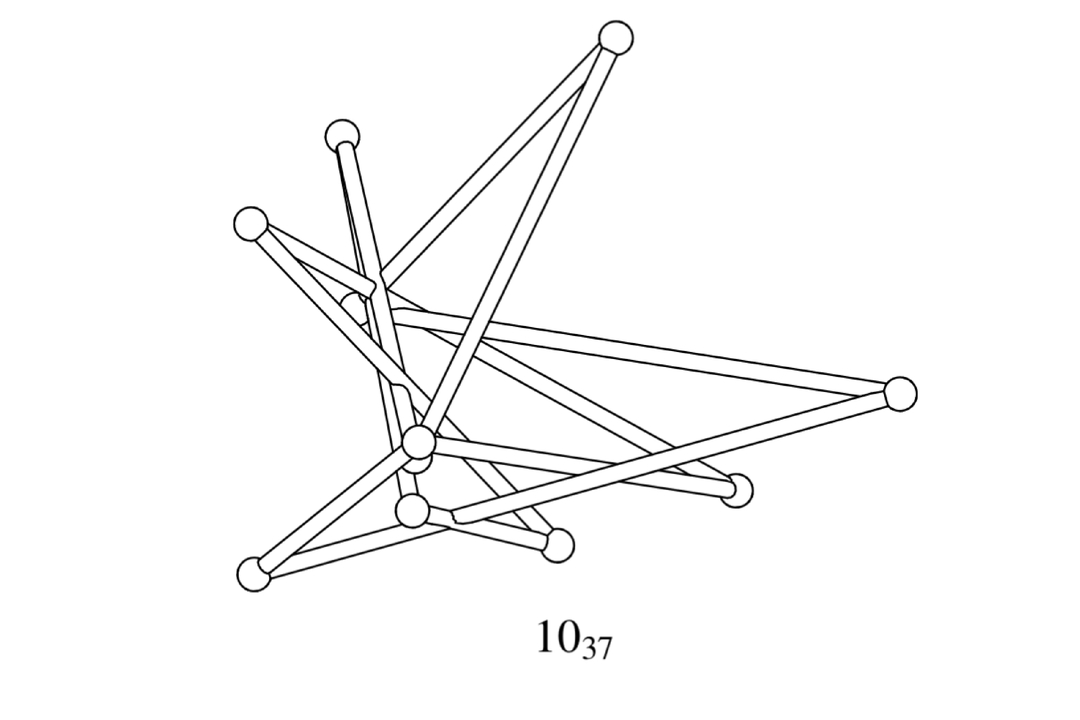
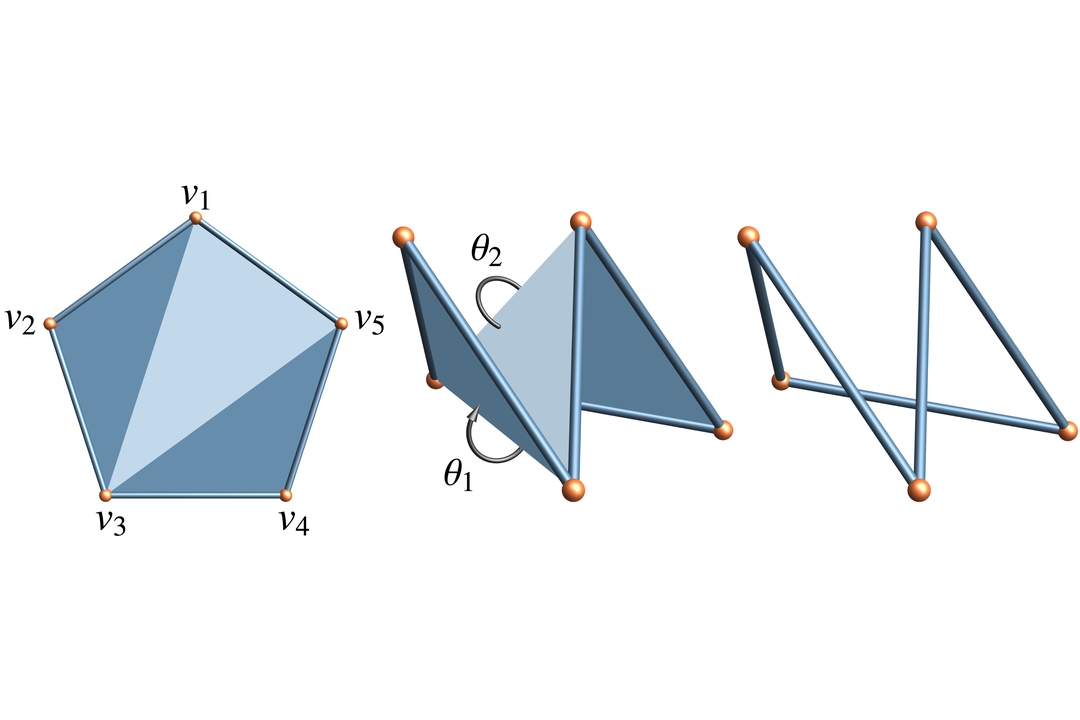
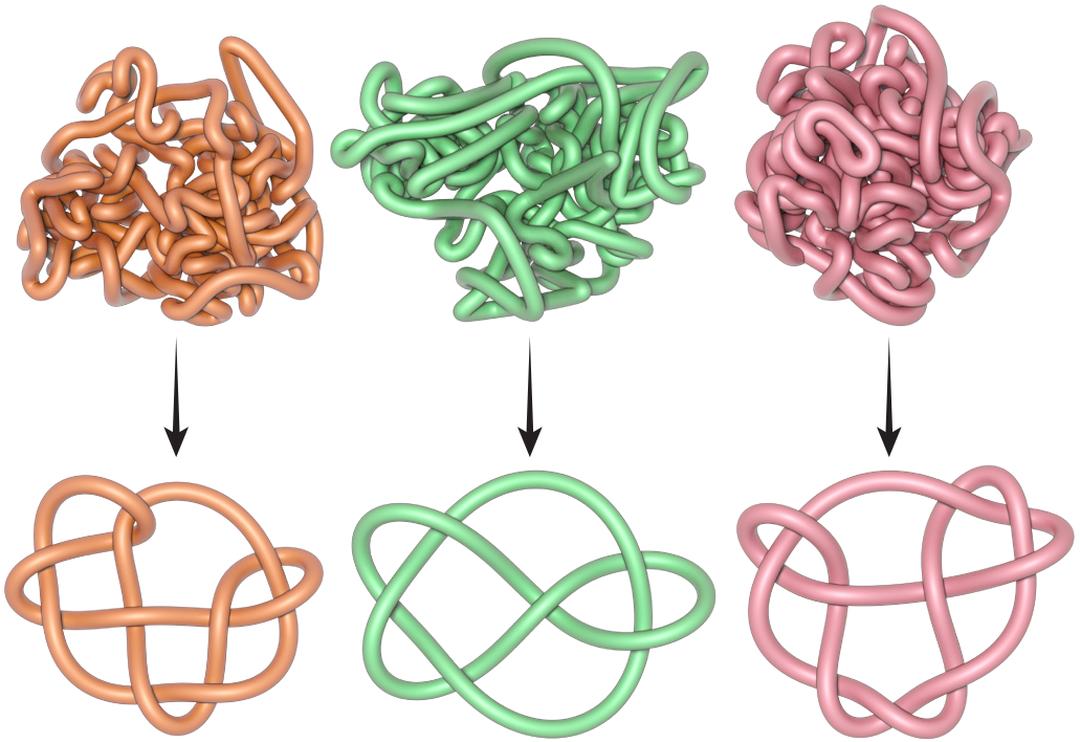
We use a version of simulated annealing with knot-type preserving moves to find polygonal representatives of various knot types with low stick number. These give better bounds on stick numbers of prime knots through 10 crossings, and for the first time give a comprehensive table of stick number bounds on all knots through 13 crossings. These are equal to existing lower bounds (and hence determine the stick number exactly) for 19 knot types whose exact stick number was not known previously.
PDF arxiv
|
|
|
|
Random knotting in very long off-lattice self-avoiding polygons
Jason Cantarella, Tetsuo Deguchi, Henrik Schumacher, Clayton Shonkwiler, Erica Uehara (2026)
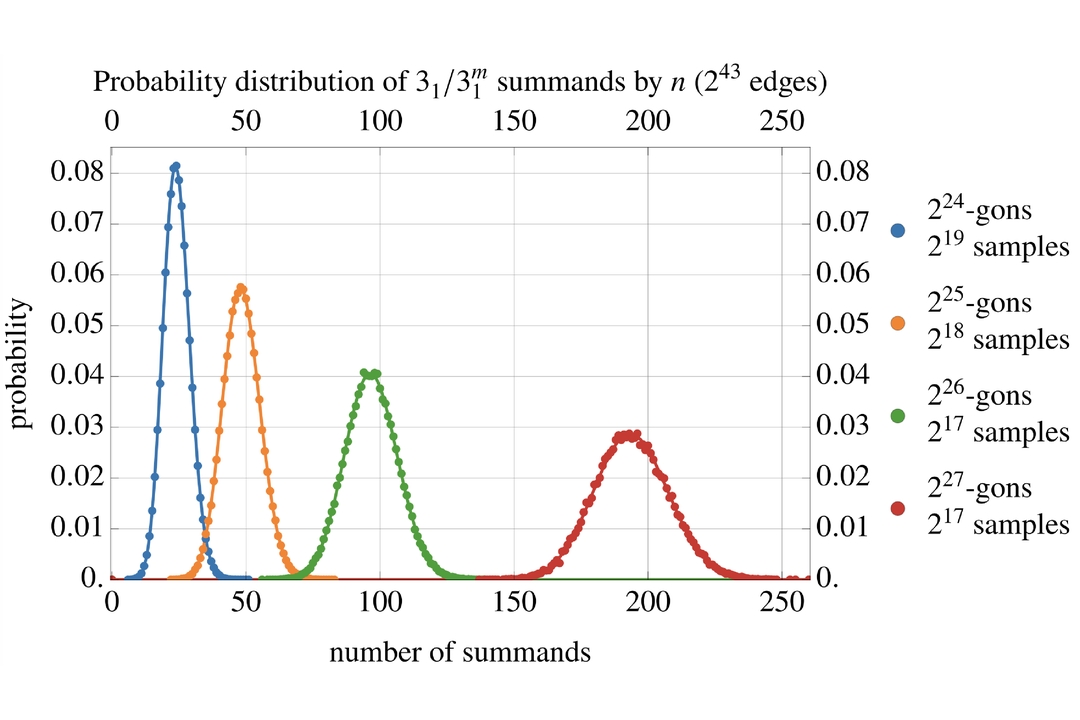
We present experimental results on knotting in off-lattice self-avoiding polygons in the bead-chain model. Using Clisby's tree data structure and the scale-free pivot algorithm, for each $k$ between $10$ and $27$ we generated $2^{43-k}$ polygons of size $n=2^k.$ Using a new knot diagram simplification and invariant-free knot classification code, we were able to determine the precise knot type of each polygon. The results show that the number of prime summands of knot type $K$ in a random $n$-gon is very well described by a Poisson distribution. We estimate the characteristic length of knotting as $656500 \pm 2500$. We use the count of summands for large $n$ to measure knotting rates and amplitude ratios of knot probabilities more accurately than previous experiments. Our calculations agree quite well with previous on-lattice computations, and support both knot localization and the knot entropy conjecture.
arxiv
|
|
|
|
Inverse obstacle scattering regularized by the tangent-point energy
Henrik Schumacher, Jannik Rönsch, Thorsten Hohage, Max Wardetzky (2025)
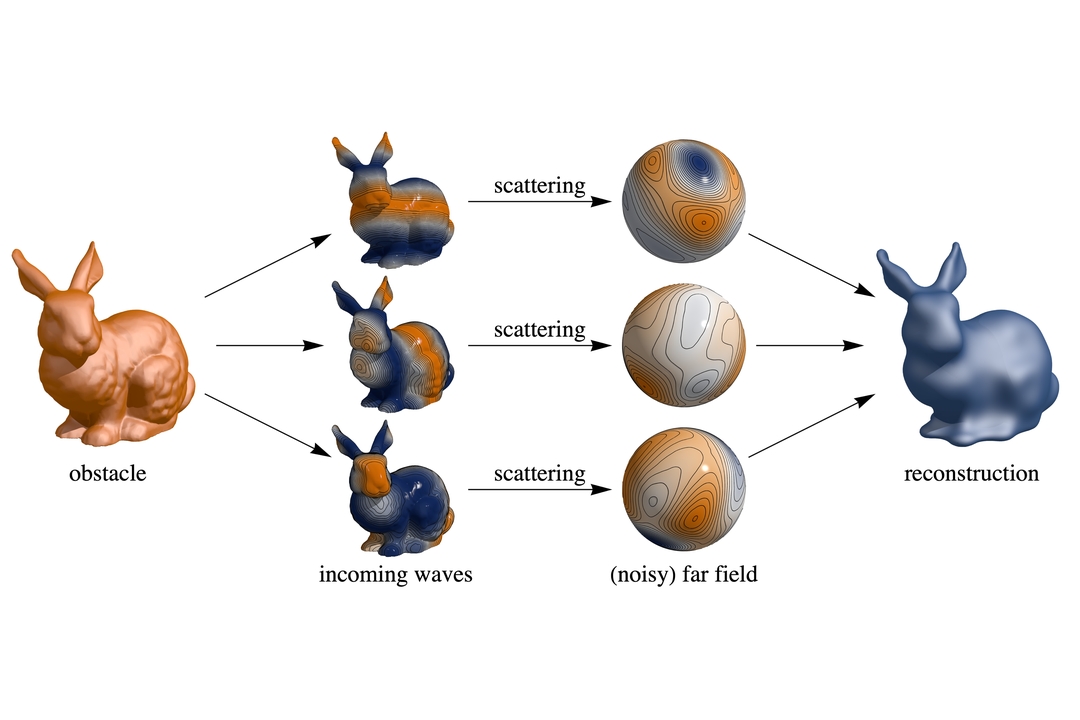
We employ the so-called tangent-point energy as Tikhonov regularizer for ill-conditioned inverse scattering problems in $3D$.The tangent-point energy is a self-avoiding functional on the space of embedded surfaces that also penalizes surface roughness. Moreover, it features nice compactness and continuity properties. These allow us to show the well-posedness of the regularized problems and the convergence of the regularized solutions to the true solution in the limit of vanishing noise level. We also provide a reconstruction algorithm of iteratively regularized Gauss-Newton type. Our numerical experiments demonstrate that our method is numerically feasible and effective in producing reconstructions of unprecedented quality.
arxiv
|
|
|
|
On the Palais--Smale condition in geometric knot theory
Nicolas Freches, Henrik Schumacher, Daniel Steenebrügge, Heiko von der Mosel (2025)
We prove that various families of energies relevant in geometric knot theory satisfy the Palais-Smale condition (PS) on submanifolds of arclength parametrized knots. These energies include linear combinations of the Euler-Bernoulli bending energy with a wide variety of non-local knot energies, such as O'Hara's self-repulsive potentials $E^{\alpha,p}$, generalized tangent-point energies $\mathrm{TP}^{(p,q)}$, and generalized integral Menger curvature functionals $\mathrm{intM}^{(p,q)}$. Even the tangent-point energies $\mathrm{TP}^{(p,2)}$ for $p\in (4,5)$ alone are shown to fulfill the (PS)-condition. For all energies mentioned we can therefore prove existence of minimizing knots in any prescribed ambient isotopy class, and we provide long-time existence of their Hilbert-gradient flows, and subconvergence to critical knots as time goes to infinity. In addition, we prove $C^\infty$-smoothness of all arclength constrained critical knots, which shows in particular that these critical knots are also critical for the energies on the larger open set of regular knots under a fixed-length constraint.
arxiv
|
|
|
|
On a Complete Riemannian Metric on the Space of Embedded Curves
Elias Döhrer, Philipp Reiter, Henrik Schumacher (2025)
We propose a new strong Riemannian metric on the manifold of (parametrized) embedded curves of regularity $H^s$, $s\in(3/2,2)$. We highlight its close relationship to the (generalized) tangent-point energies and employ it to show that this metric is complete in the following senses: (i) bounded sets are relatively compact with respect to the weak $H^s$ topology; (ii) every Cauchy sequence with respect to the induced geodesic distance converges; (iii) solutions of the geodesic initial-value problem exist for all times; and (iv) there are length-minimizing geodesics between every pair of curves in the same path component (i.e., in the same knot class). As a by-product, we show $C^\infty$-smoothness of the tangent-point energies in the Hilbert case.
arxiv
|
|
|
|
CoBarS: Fast reweighted sampling for polygon spaces in any dimension
Jason Cantarella, Henrik Schumacher (2024)
Abstract. We present the first algorithm for sampling random configurations of closed \(n\)-gons with any fixed edgelengths \(r_1, \dots, r_n\) in any dimension \(d\) which is proved to sample correctly from standard probability measures on these spaces. We generate open \(n\)-gons as weighted sets of edge vectors on the unit sphere and close them by taking a Möbius transformation of the sphere which moves the center of mass of the edges to the origin. Using previous results of the authors, such a Möbius transformation can be found in \(O(n)\) time. The resulting closed polygons are distributed according to a pushforward measure. The main contribution of the present paper is the explicit calculation of reweighting factors which transform this pushforward measure to any one of a family of standard measures on closed polygon space, including the symplectic volume for polygons in \({\mathbb{R}}^3\). For fixed dimension, these reweighting factors may be computed in \(O(n)\) time. Experimental results show that our algorithm is efficient and accurate in practice, and an open-source reference implementation is provided.
PDF arxiv
|
|
|
|
On the average squared radius of gyration of a family of embeddings of subdivision graphs
Jason Cantarella, Henrik Schumacher, Clayton Shonkwiler (2024)
We consider graphs created by subdividing each edge of a "structure" graph $G'$ into $n$ parts to create a graph $G$. Every embedding of $G$ yields a corresponding embedding of $G'$. We consider a family of embeddings of $G$ which give rise to a single embedding of $G'$ constructed by permuting the edges of $G'$, and give a simple formula for the average radius of gyration of such embeddings in terms of a weighted radius of gyration for the structure graph $G'$ and the sum of the squares of the lengths of the edges of $G$ and $G'$. In a companion paper, we use this formula to compute exact values of the ensemble average of radius of gyration for Gaussian topological polymers modeled on subdivision graphs.
arxiv
|
|
|
|
Repulsive Shells
Josua Sassen, Henrik Schumacher, Martin Rumpf, Keenan Crane (2024)
This paper develops a shape space framework for collision-aware geometric modeling, where basic geometric operations automatically avoid inter-penetration. Shape spaces are a powerful tool for surface modeling, shape analysis, nonrigid motion planning, and animation, but past formulations permit nonphysical intersections. Our framework augments an existing shape space using a repulsive energy such that collision avoidance becomes a first-class property, encoded in the Riemannian metric itself. In turn, tasks like intersection-free shape interpolation or motion extrapolation amount to simply computing geodesic paths via standard numerical algorithms. To make optimization practical, we develop an adaptive collision penalty that prevents mesh self-intersection, and converges to a meaningful limit energy under refinement. The final algorithms apply to any category of shape, and do not require a dataset of examples, training, rigging, nor any other prior information. For instance, to interpolate between two shapes we need only a single pair of meshes with the same connectivity. We evaluate our method on a variety of challenging examples from modeling and animation.
PDF
|
|
|
|
A faster direct sampling algorithm for equilateral closed polygons and the probability of knotting
Jason Cantarella, Henrik Schumacher, Clayton Shonkwiler (2024)
We present a faster direct sampling algorithm for random equilateral closed polygons in three-dimensional space. This method improves on the moment polytope sampling algorithm of Cantarella et al (2016 J. Phys. A: Math. Theor. 49 275202) and has (expected) time per sample quadratic in the number of edges in the polygon. We use our new sampling method and a new code for computing invariants based on the Alexander polynomial to investigate the probability of finding unknots among equilateral closed polygons.
PDF arxiv
|
|
|
|
A speed preserving Hilbert gradient flow for generalized integral Menger curvature
Jan Knappmann, Henrik Schumacher, Daniel Steenebrügge, Heiko von der Mosel (2023)
We establish long-time existence for a projected Sobolev gradient flow of generalized integral Menger curvature in the Hilbert case and provide $C^{1,1}$-bounds in time for the solution that only depend on the initial curve. The self-avoidance property of integral Menger curvature guarantees that the knot class of the initial curve is preserved under the flow, and the projection ensures that each curve along the flow is parametrized with the same speed as the initial configuration. Finally, we describe how to simulate this flow numerically with substantially higher efficiency than in the corresponding numerical $L^2$ gradient descent or other optimization methods.
PDF arxiv
|
|
|
|
Computing the Conformal Barycenter
Jason Cantarella, Henrik Schumacher (2022)
The conformal barycenter of a point cloud on the sphere at infinity of the Poincaré ball model of hyperbolic space is a hyperbolic analogue of the geometric median of a point cloud in Euclidean space. It was defined by Douady and Earle as part of a construction of a conformally natural way to extend homeomorphisms of the circle to homeomorphisms of the disk, and it plays a central role in Millson and Kapovich's model of the configuration space of cyclic linkages with fixed edge lengths. In this paper we consider the problem of computing the conformal barycenter. Abikoff and Ye have given an iterative algorithm for measures on $\mathbb{S}^1$ which is guaranteed to converge. We analyze Riemannian versions of Newton's method computed in the intrinsic geometry of the Poincare ball model. We give Newton-Kantorovich (NK) conditions under which we show that Newton's method with fixed step size is guaranteed to converge quadratically to the conformal barycenter for measures on any $\mathbb{S}^d$ (including infinite-dimensional spheres). For measures given by $n$ atoms on a finite-dimensional sphere which obey the NK conditions, we give an explicit linear bound on the computation time required to approximate the conformal barycenter to fixed error. We prove that our NK conditions hold for all but exponentially few $n$ atom measures. For all measures with a unique conformal barycenter we show that a regularized Newton's method with line search will always converge (eventually superlinearly) to the conformal barycenter. Though we do not have hard time bounds for this algorithm, experiments show that it is extremely efficient in practice and in particular much faster than the Abikoff-Ye iteration.
PDF arxiv
|
|
|
|
Sobolev gradients for the {Möbius} energy
Philipp Reiter, Henrik Schumacher (2021)
Aiming to optimize the shape of closed embedded curves within prescribed isotopy classes, we use a gradient-based approach to approximate stationary points of the Möbius energy. The gradients are computed with respect to Sobolev inner products similar to the $W^{3/2,2}$-inner product. This leads to optimization methods that are significantly more efficient and robust than standard techniques based on $L^2$-gradients.
PDF arxiv
|
|
|
|
Repulsive Curves
Chris Yu, Henrik Schumacher, Keenan Crane (2021)
Curves play a fundamental role across computer graphics, physical simulation, and mathematical visualization, yet most tools for curve design do nothing to prevent crossings or self-intersections. This article develops efficient algorithms for (self-)repulsion of plane and space curves that are well-suited to problems in computational design. Our starting point is the so-called tangent-point energy, which provides an infinite barrier to self-intersection. In contrast to local collision detection strategies used in, e.g., physical simulation, this energy considers interactions between all pairs of points, and is hence useful for global shape optimization: local minima tend to be aesthetically pleasing, physically valid, and nicely distributed in space. A reformulation of gradient descent based on a Sobolev-Slobodeckij inner product enables us to make rapid progress toward local minima---independent of curve resolution. We also develop a hierarchical multigrid scheme that significantly reduces the per-step cost of optimization. The energy is easily integrated with a variety of constraints and penalties (e.g., inextensibility, or obstacle avoidance), which we use for applications including curve packing, knot untangling, graph embedding, non-crossing spline interpolation, flow visualization, and robotic path planning.
PDF arxiv
|
|
|
|
Repulsive Surfaces
Chris Yu, Caleb Brakensiek, Henrik Schumacher, Keenan Crane (2021)
Functionals that penalize bending or stretching of a surface play a key role in geometric and scientific computing, but to date have ignored a very basic requirement: in many situations, surfaces must not pass through themselves or each other. This paper develops a numerical framework for optimization of surface geometry while avoiding (self-)collision. The starting point is the tangent-point energy, which effectively pushes apart pairs of points that are close in space but distant along the surface. We develop a discretization of this energy for triangle meshes, and introduce a novel acceleration scheme based on a fractional Sobolev inner product. In contrast to similar schemes developed for curves, we avoid the complexity of building a multiresolution mesh hierarchy by decomposing our preconditioner into two ordinary Poisson equations, plus forward application of a fractional differential operator. We further accelerate this scheme via hierarchical approximation, and describe how to incorporate a variety of constraints (on area, volume, etc.). Finally, we explore how this machinery might be applied to problems in mathematical visualization, geometric modeling, and geometry processing.
PDF arxiv
|
|
|
|
Variational Methods for Discrete Geometric Functionals
Henrik Schumacher, Max Wardetzky (2020)
While consistent discrete notions of curvatures and differential operators have been widely studied, the question of whether the resulting minimizers converge to their smooth counterparts still remains open for various geometric functionals. Building on tools from variational analysis, and in particular using the notion of Kuratowski convergence, we offer a general framework for treating convergence of minimizers of (discrete) geometric functionals. We show how to apply the resulting machinery to minimal surfaces and Euler elasticae.
PDF
|
|
|
|
Variational convergence of discrete elasticae
Sebastian Scholtes, Henrik Schumacher, Max Wardetzky (2020)
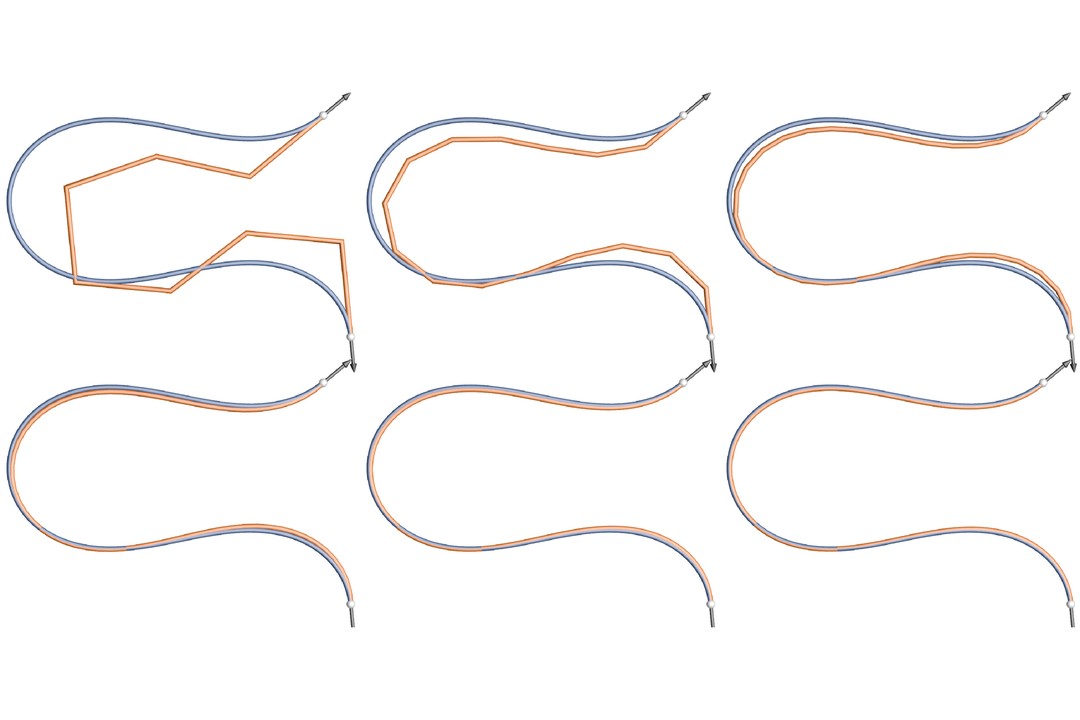
We discuss a discretization of the Euler-Bernoulli bending energy and of Euler elasticae under clamped boundary conditions by polygonal lines. We show Hausdorff convergence of the set of almost minimizers of the discrete bending energy to the set of smooth Euler elasticae under mesh refinement in (i) the $W^{1,\infty}$-topology for piecewise-linear interpolation; and in (ii) the $W^{2,p}$-topology, $p \in [2,\infty [$, using a suitable smoothing operator to create $W^{2,p}$-curves from polygons.
PDF arxiv
|
|
|
|
Maximal discrete sparsity in parabolic optimal control with measures
Evelyn Herberg, Michael Hinze, Henrik Schumacher (2019)
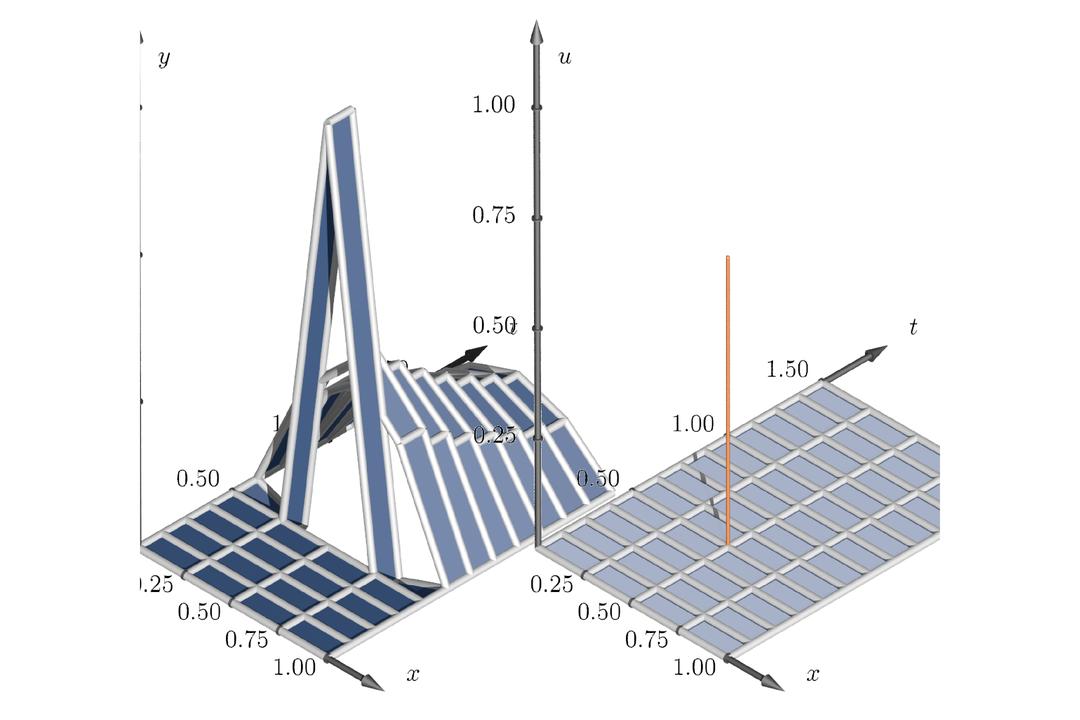
We consider variational discretization of a parabolic optimal control problem governed by space-time measure controls. For the state discretization we use a Petrov-Galerkin method employing piecewise constant states and piecewise linear and continuous test functions in time. For the space discretization we use piecewise linear and continuous functions. As a result the controls are composed of Dirac measures in space-time, centered at points on the discrete space-time grid. We prove that the optimal discrete states and controls converge strongly in $L^q$ and weakly-$*$ in $\mathcal{M}$, respectively, to their smooth counterparts, where $q \in (1,\min\{2,1+2/d\}]$ is the spatial dimension. Furthermore, we compare our approach to [Casas, Kunisch - Parabolic control problems in space-time measure spaces], where the corresponding control problem is discretized employing a discontinuous Galerkin method for the state discretization and where the discrete controls are piecewise constant in time and Dirac measures in space. Numerical experiments highlight the features of our discrete approach.
PDF
|
|
|
|
Elastic energy regularization for inverse obstacle scattering problems
J. Eckhardt, R. Hiptmair, T. Hohage, H. Schumacher, M. Wardetzky (2019)
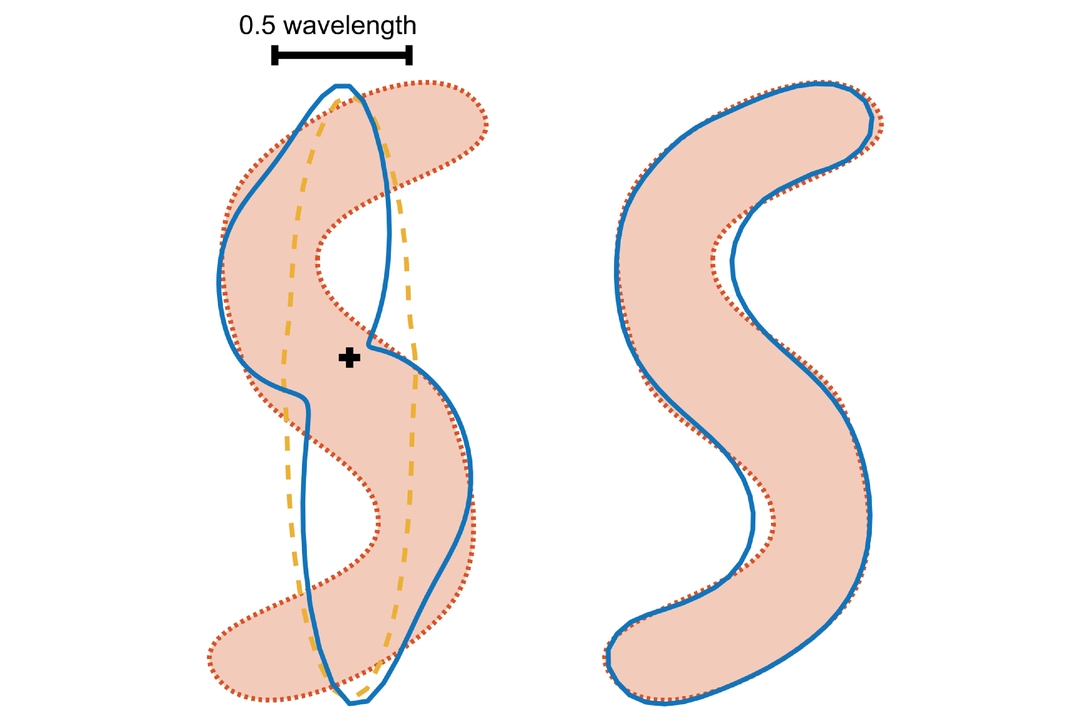
This paper is motivated by inverse problems in which the boundary curve of a smooth bounded domain has to be reconstructed from indirect measurements. As a classical example we study acoustic inverse obstacle scattering problems for cylindrical sound-soft scatterers using far-field measurements of scattered time-harmonic waves. By introducing a shape manifold as a solution set we allow the reconstruction of general, not necessarily star-shaped, curves. The bending energy is used as a stabilizing term in Tikhonov regularization to gain independence of the parametrization. Moreover, we discuss how self-intersections can be avoided by penalization with the Möbius energy and prove the regularizing property of our approach as well as convergence rates under variational source conditions. In a second part of the paper a discrete setting is introduced, and we describe a numerical method for finding the minimizer of the Tikhonov functional on the shape-manifold. Numerical examples demonstrate that our method can reconstruct non-star-shaped obstacles.
PDF arxiv
|
|
|
|
Variational convergence of discrete minimal surfaces
Henrik Schumacher, Max Wardetzky (2019)
Building on and extending tools from variational analysis and relying on certain a priori assumptions, we prove Kuratowski convergence of sets of simplicial area minimizers to minimizers of the smooth Douglas-Plateau problem under simplicial refinement. This convergence is with respect to a topology that is finer than the topology of uniform convergence of both positions and surface normals.
PDF arxiv
|
|
|
|
Pseudogradient flows of geometric energies
Henrik Schumacher (2018)
For differentiable functions on Riemannian manifolds, the gradient vector field and its induced gradient flow are well-defined and well-understood concepts. Unfortunately, many nonquadratic, infinite-dimensional optimization problems cannot be formulated on Riemannian manifolds in a convenient way. We introduce a category of infinite-dimensional Banach manifolds that allows us to define a generalized gradient. Moreover, we show short-time existence of the induced flows and apply their discretizations to the numerical minimization of various geometric energies of immersed curves and surfaces.
PDF
|